

Café · Montreal · ⭐ 9.3/10 · 2113 reviews · updated: 2026-08-10 15:33:12
Address: 1067 Rue de Bleury, Montréal, QC H2Z 1N1, Canada
An accountant and a biologist walk out of their careers because they love coffee: the kind of story that could easily stay a pretty line in a brand deck. At La Finca café & marché local it has very concrete consequences, and the first one is right there in the name. In Spanish, «la finca» means the farm — not the bean, not the cup, not the machine: the farm. Everything this downtown address does follows from the decision to start at the far end of the chain.
Highlights
- An exclusive lot from a single family. The house coffee, called Sueños de Pichingo, is grown by Clementino, his wife and their son on their farm in the mountains of Comayagua, Honduras. This is not a single origin picked off an importer’s catalogue — it is a reserved lot, harvest after harvest.
- Buying done through an importer with a position. La Finca works with Semilla Coffee and its collective-buying model: multi-year commitments, fair pre-financing, technical support and payment above world prices, with whole containers bought jointly by several cafés and roasteries so that very small growers can reach the specialty market at all.
- Opened in August 2016 by two friends who left accountancy and biology, trained behind a machine, and went to see with their own eyes what a plantation actually looks like before opening anything.
- Everything is made by hand on site, including the bread. That is rare for a café this size, and it is what transforms the lunch plate.
- A genuine market inside the café: fruit and vegetables, farm produce, microbrewery beer, natural wine and the house beans all go home with customers. You can come in for an espresso and leave with dinner.
- Three private rooms bookable by the hour, for one to ten people — the house has carried a second identity as a neighbourhood office since day one.
What’s in the cup
Take the name literally. Most specialty cafés tell you about the bean starting from the sack: origin, altitude, process, tasting notes. La Finca tells you about the bean starting from the people. What is poured here comes from Honduras, from the highlands of Comayagua, from a family holding run by Clementino with his wife and their son — and the house calls him by his first name because the relationship really is direct. The profile matches the provenance: a creamy, enveloping, caramelized cup, tilted toward sweetness and body rather than the bright acidity that Nordic roasters chase.
The commercial machinery behind that cup deserves explaining, because that is where the difference actually lives. Buying direct from a very small grower is easier said than done: a neighbourhood café cannot fill a shipping container on its own. So La Finca goes through Semilla Coffee, an independent importer that organizes joint purchasing across several cafés and roasteries. The mechanism includes a commitment across several harvests, pre-financing so the family does not have to borrow before the picking season, technical support on the ground, and a price above world market rates. This is not a logo printed on a bag; it is a supply chain deliberately built.
Nor is any of this recent. From the opening in 2016 the founders wanted to know the person growing their coffee, and the first relationship of that kind tied them to a producer in Costa Rica before the Honduran project took over. One point calls for honesty, though: the house does not publicly say who roasts the beans or where, and we are not going to invent it. What is documented is the upstream — the farm, the grower, the buying model — which is the exact reverse of what most cafés put forward. Beside the espresso, the counter makes its own lemonades, iced teas and blended drinks, which keeps the room liveable in high summer for anyone avoiding caffeine.
Who’s behind it
Geneviève Loignon-Houle and Marie-Laurence Guindon were friends before they were business partners. One came from accountancy, the other from biology, and both eventually found their professional world suffocating. A shared love of coffee could have stayed a hobby; instead they turned it into a project and prepared seriously — first learning the craft behind a machine, then travelling to Central America, to El Salvador, to see what a plantation genuinely looks like before saying a word about it to anyone. That order of operations explains almost everything about the result.
The second founding instinct was more prosaic: they had noticed that downtown badly lacked places to work that were neither an office nor home. The idea of a café doubling as a workplace was there on day one — before remote work became a society-wide subject — and that is where the bookable private rooms come from. The premises, found on an artery running down toward Old Montreal, were laid out around that double function.
What it’s good for
This is the most interesting thing about the address, because there is a genuine subtlety to it. For a serious working session, the right answer is not the main room — it is the private rooms. They book by the hour, hold one to ten people, and turn the café into a temporary office: a client meeting, a committee, a study group, an interview. That is a rare service in the middle of downtown and the single best reason to know this place exists.
In the open room the picture is more nuanced, and it is better said plainly. The space is bright, quiet and comfortable, but it has evolved toward brunch and lunch rather than toward a nursery of laptops; regulars note that an open computer on a big shared table feels slightly out of place once the room fills up. An hour of email, no problem. A whole day — book a room, which is precisely what they are there for.
For talking, the address is excellent: the noise floor stays low, which is close to unobtainable downtown. For coming alone, the daylight and the pale wood make it easy, with a book or with nothing. For takeaway, it is efficient, and the market side means you can add bread, a vegetable or a bottle to the cup. For a weekend brunch, this is probably the house’s most popular use, and its busiest.
The space and the atmosphere
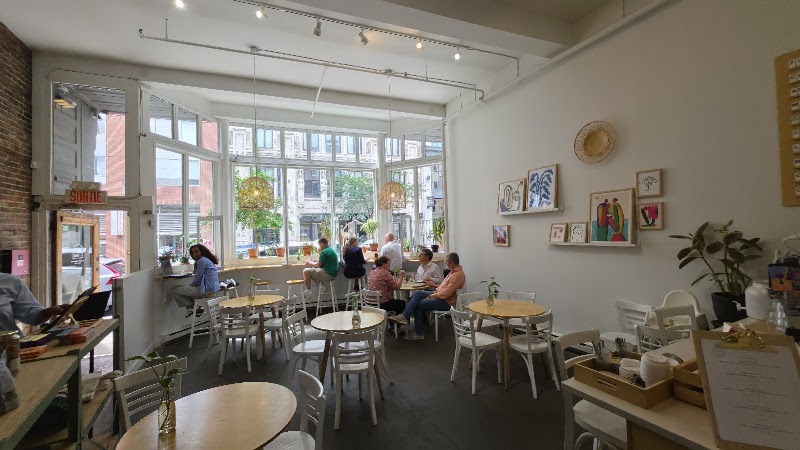
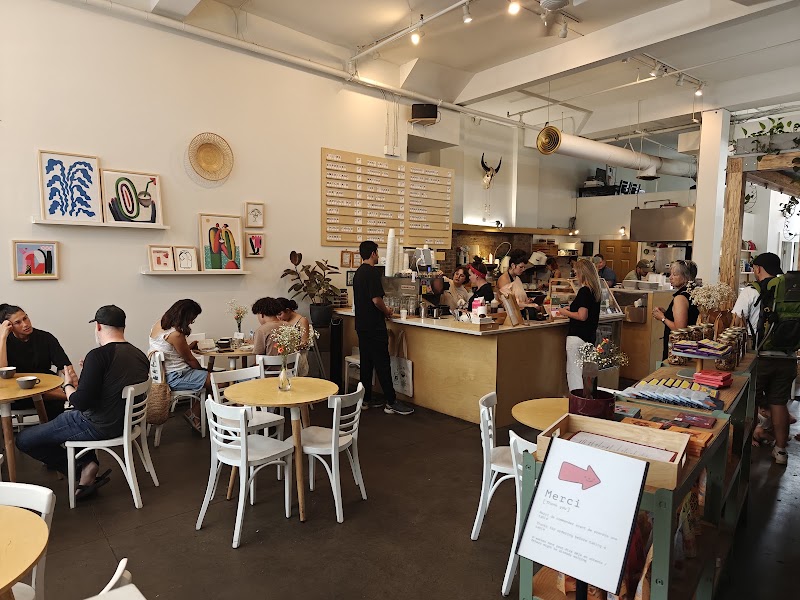
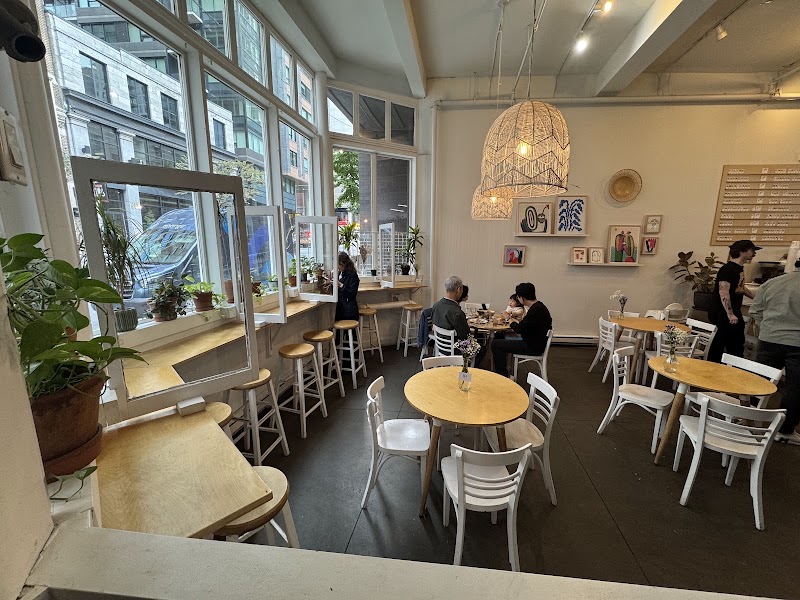
Pale wood, big windows, a great deal of natural light, minimalism without chill. Market shelving takes up part of the room and gives the place its character: this is not a white box built around an espresso machine but a space where jars, bags of beans and farm produce are part of the decor because they are for sale. The tables run generous, the furniture makes no attempt to show off, and the overall impression is of a workshop kept tidy.
Almost everybody describes the mood the same way: a café at human scale, sincere, without a pose. The volume is low on weekdays and noticeably livelier on Saturday and Sunday at brunch time. The clientele is made up of people working in the sector, neighbourhood regulars and, at the weekend, tables that have come specifically to eat. The private rooms sit apart, which protects the meeting and the main room at the same time.
Beyond the coffee
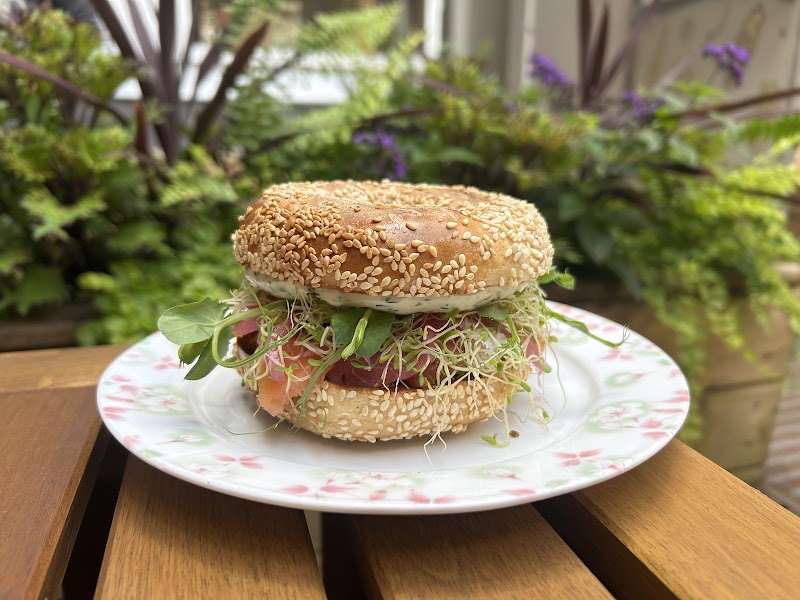
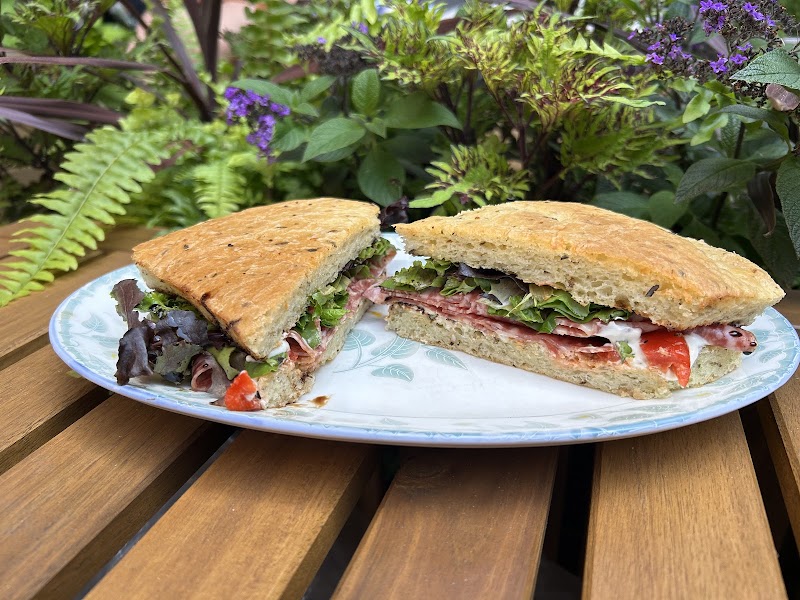
Here the answer is unambiguous: they cook, and they bake. The morning and midday menu fits on a few lines — toasts, sandwiches, salads, soups, pastry — but all of it is made by hand on site, including the bread, which is frankly unusual for a café of this size. The house granola is even sold by the bag to take away. That coherence between the cup and the plate is why the place works equally well as a weekday canteen and as a weekend brunch room.
The second half of the business is the market. Fruit and vegetables, farm produce, microbrewery beer, natural wine and, of course, the house beans. There is also a catering service and a home delivery run one day a week. It is a hybrid model that makes a great deal of sense in a district where the office towers empty the streets by evening: the same room serves as a café in the morning, a canteen at midday and a fine grocery at the end of the day.
When to come
The rhythm here is a daytime one, and it is worth knowing before you set out: the house opens with the working day and shuts at the end of the afternoon. This is not an evening address, and nobody is coming here for an espresso after dinner. Early on a weekday is the calmest window and the best one if you want the room to yourself. Midday belongs to the people working in the towers nearby. At the weekend, from mid-morning into the early afternoon, brunch takes command and the crowd thickens noticeably. If you are aiming for a private room, book well ahead.
Getting there
You are downtown, on the edge of the Quartier des spectacles and the international district, in that hinge zone where office towers start giving way to concert halls. Place-d’Armes station on the orange line and Place-des-Arts on the green line are both a few minutes on foot; Square-Victoria–OACI is a little further but perfectly walkable. The sector is very well served by buses, threaded with cycle paths and entirely walkable. By car it is downtown in every sense: paid underground parking, one-way streets and recurring construction — better to arrive some other way.
Good to know
A few useful specifics. There is only one address: this is not a chain, and there is no second branch to confuse with this one. The meeting rooms are few, they are booked, and they go quickly at the obvious hours. Since the house closes at the end of the afternoon, do not count on it to end your day. The market side depends on deliveries, so what was on the shelf last week may not be there today. And finally, the thing you have to accept: the house says a great deal about the upstream of coffee — the farm, the family, the buying model — and almost nothing about the roast itself. If your criterion is knowing exactly who put the beans over the fire and when, you will go hungry; if your criterion is knowing who grew them and on what terms, very few addresses in the city answer as precisely.
Questions and answers
Where does the coffee come from?
From Honduras, from the mountains of Comayagua, from a family farm run by Clementino with his wife and their son. The lot is exclusive to the house and is called Sueños de Pichingo.
Do they roast it themselves?
It is not stated publicly. The house documents the buying, the farm and the grower in detail, but not the roasting, and we would rather not fill that gap with a guess.
Can you work there?
Yes, but pick the right format. For an hour, the main room is fine. For a real session or a meeting, book one of the private rooms, sized for one to ten people — that is the service that most distinguishes this address.
Is it genuinely a shop as well?
Yes, and not symbolically. Fruit and vegetables, farm produce, microbrewery beer, natural wine and the house beans are all sold on site, alongside a catering service.
Is the bread baked on the premises?
Yes. The kitchen makes everything by hand, bread included, which is rare for a café this size and explains the quality of the midday sandwiches.
Is there a terrace?
Nothing documents one publicly, and the geometry of the district — narrow pavements, heavy traffic, office towers — does not invite one. Assume the experience is an indoor one.
Is it open in the evening?
No. This is a daytime café that opens with the working day and closes at the end of the afternoon. For a late espresso you will need a different sign.
Is it a good spot for weekend brunch?
It is one of the house’s most popular uses, with a kitchen that cooks and bakes on site. Just expect the room to be noticeably livelier than on a weekday.
Opening hours
| Day | Hours |
|---|---|
| Monday | 08:00–16:00 |
| Tuesday | 08:00–16:00 |
| Wednesday | 08:00–16:00 |
| Thursday | 08:00–16:00 |
| Friday | 08:00–16:00 |
| Saturday | 08:00–16:00 |
| Sunday | 08:00–16:00 |
Photos
Visitor reviews
Reviews last updated: 2026-08-10 15:33:12
Data is refreshed monthly. Sources: montrealanka.com and editorial picks based on reviews.
Чудовий магазин. Дуже дружелюбна атмосфера, чудова кава та приємна робоча атмосфера. Я також скуштував шакшука, яка була чудова — трохи м'яка, але смачна. Той факт, що в них є кілька хороших варіантів їжі, робить їх чудо…
Чудова маленька незалежна кав'ярня, яка пропонує смачний лате з вівсяним молоком у поєднанні з шоколадним десертом, що було просто неймовірно. Мені подобається пропускати мережеві кав'ярні та знаходити такі маленькі перл…
Чудова їжа, все було фантастично, хліб фокачі був найкращим сендвічем, який я їв за останні роки. Кава була дуже смачною, обслуговування також дуже швидким. Я скоро повернуся, дуже розумні ціни. Також смачна випічка.
Єдине місце, куди я заїжджав двічі під час своєї поїздки до Монреаля. Персонал привітний і готовий допомогти. Але нам треба поговорити про бейгл-бейгл! Я досі думаю про це, навіть через кілька місяців. Мені подобається б…
Цьому закладу справді потрібно покращити сервіс. З моменту мого прибуття я чекав у черзі близько 15 хвилин, щоб зробити замовлення. Після цього нам дали столик, але сказали, що, можливо, нам доведеться переїхати, якщо зв…