

Café · Montreal · ⭐ 9.5/10 · 1177 reviews · updated: 2026-08-10 15:33:16
Address: 2055 Rue Stanley, Montréal, QC H3A 0B7, Canada
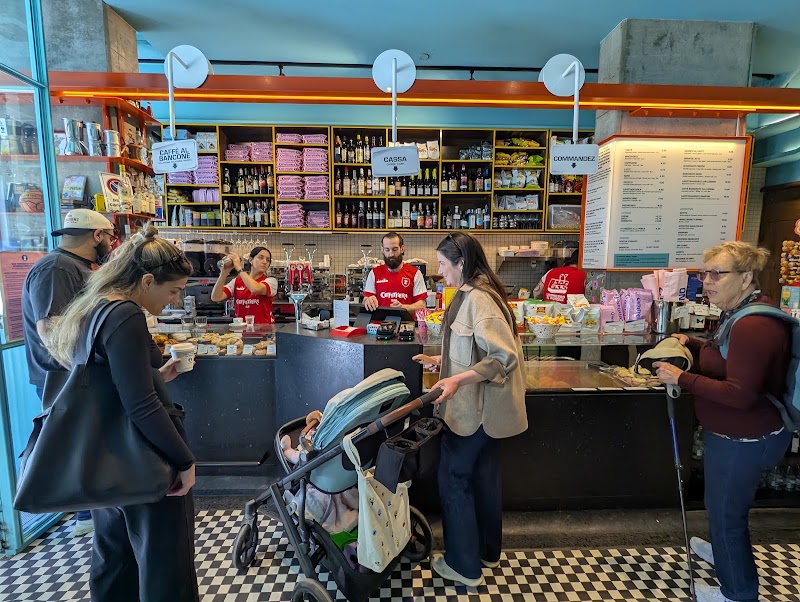
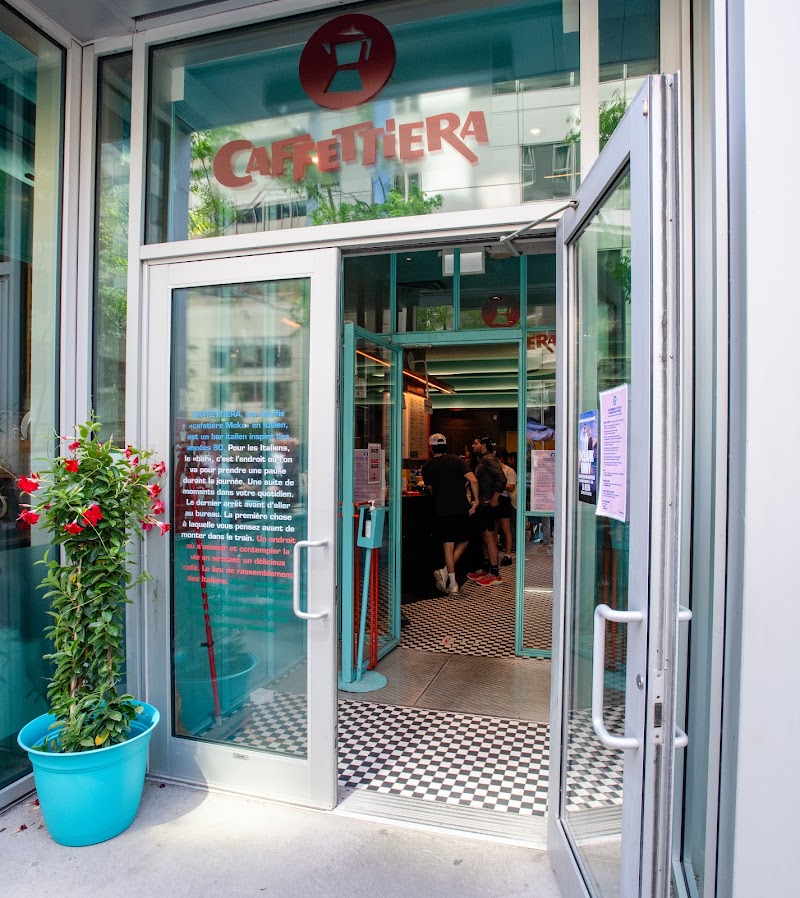
“No reservations. No telefono.” The house writes that about itself, and the line almost covers Bar Caffettiera on its own. The name is the Italian word for the moka pot, the aluminium object every Italian family keeps on the stove, and the project is precisely about transplanting into downtown Montreal what a bar means in Italy: not a lounge you settle into, but a counter you step into, drink standing, exchange two sentences at, and leave. It is a simple idea. It is also, here, surprisingly rare.
Highlights
- A stand-up bar in the Italian sense. You order at the counter and drink on the spot, often without sitting down. The format is not a consequence of limited floor area: it is the concept itself.
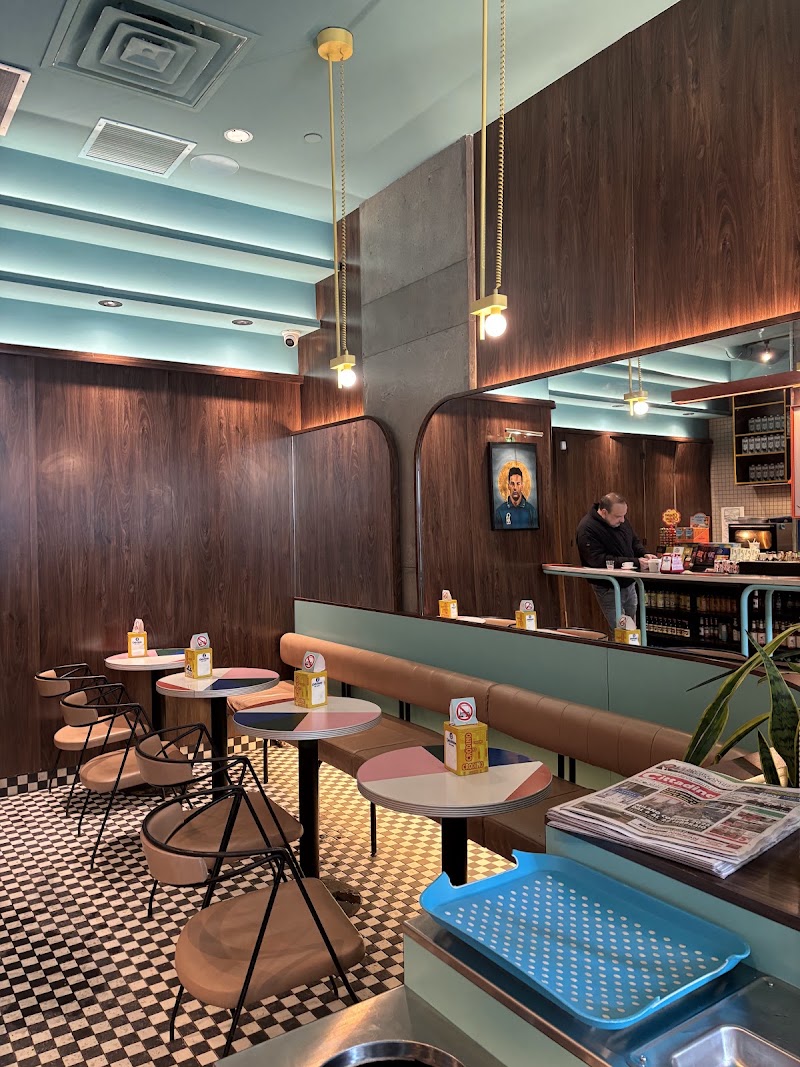
- A room that quotes the 1990s explicitly. Checkerboard tiling, sky-blue ceilings, deliberately kitsch faux wood panelling, tan leather banquettes — the work of Montreal design studio Ménard Dworkind.
- Lambert & Fils pendant lights hung from yellow telephone wire, the sort of detail that separates a designed room from a generic trattoria pastiche.
- The espresso is roasted in Italy and pulled to order on lever machines, with classic Bialetti moka pots in support — a technical position that deliberately cuts against the local scene.
- The “five M rule” is posted as a statement of belief: miscela, macinatura, macchina, manutenzione, mano — the blend, the grind, the machine, the maintenance and the hand that pulls it.
- A liquor licence and an aperitivo offer extend the day: the same counter serves the morning espresso and the late-afternoon glass, exactly as an Italian bar does.
What’s in the cup
It is worth being clear about what you get here, because it is not what a third-wave bar offers. Caffettiera does not speak the language of terroir, does not rotate micro-lots and is not chasing the bright acidity of a single-origin filter. The coffee is a blend roasted in Italy, in the dark, chocolate-leaning register that school is unapologetic about, built to hold up in milk and to be drunk short.
The interesting part is the equipment and the method. Lever machines — the piston groups where the barista loads a spring rather than pressing a button — give a declining-pressure extraction that behaves nothing like a modern electric pump. That is a rare choice in Montreal, and it produces a rounder espresso, with dense crema and a profile that forgives a grind error less readily. Alongside them, the aluminium moka pots serve the domestic version of the same coffee, the one people actually drink at home in Italy.
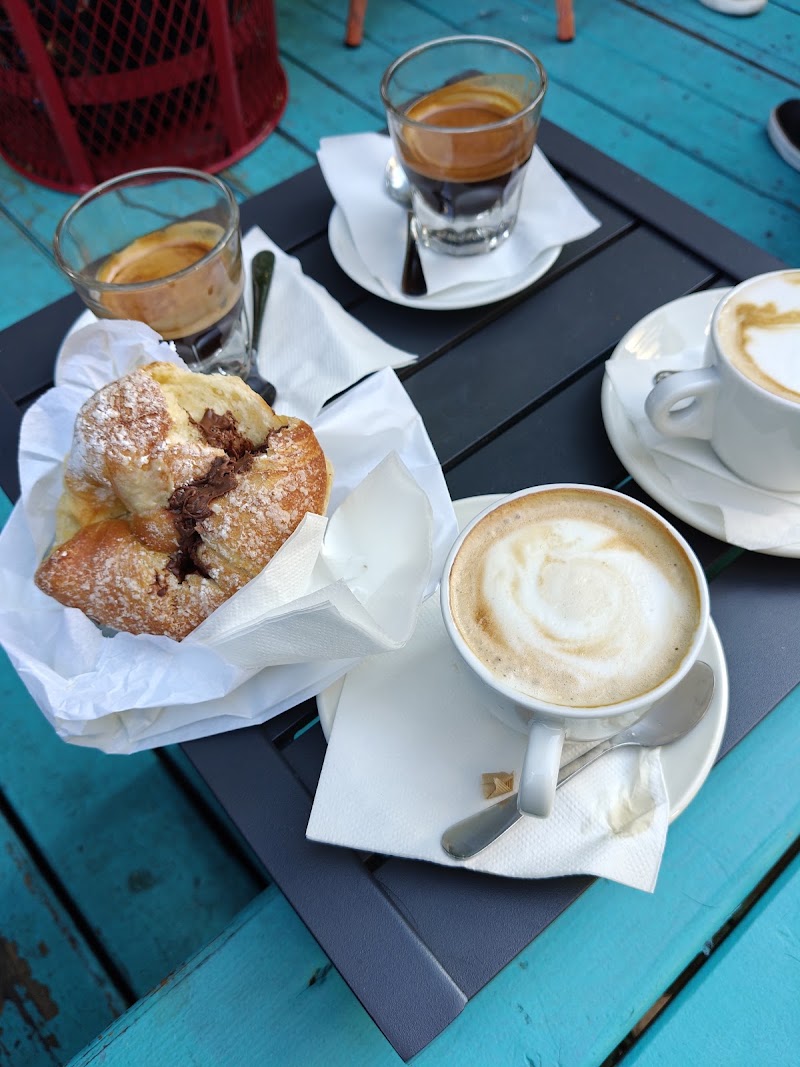
The practical conclusion: order short. Espresso, macchiato, a morning cappuccino, or the marocchino — that small construction of cocoa, espresso and milk foam that comes up most often in what people say about the place. Large takeaway formats exist, but they are not what this counter was built for, and the coffee loses exactly what makes it worth the trip.
Who’s behind it
The house does not put its founders forward, and no public profile of the ownership exists — a point where it is better to say what is unknown than to embroider. What is documented is the authorship of the space: the Montreal studio Ménard Dworkind, known for hospitality projects where the decor narrates a specific era rather than a generic style.
That matters, because the room could very easily have slid into postcard nostalgia. What saves it is the precision of the reference: this is not “Italy” in general, it is a neighbourhood Italian bar of the 1990s, with everything that decade had of the synthetic and the faintly garish. The fake wood is fake on purpose. That honesty about the pastiche is what holds the whole thing together.
What kind of visit it suits
The ten-minute break. This is the central scenario and the bar is built for it. You come in between two meetings, drink an espresso standing at the counter, trade three sentences and leave. In a district of office towers, that is a genuine service.
Working on a laptop: no, and that is not a flaw. It needs saying clearly to avoid disappointment: the room is small and loud, the music is present, seating is limited and the standing format discourages settling in. This is not a place hostile to computers; it is a place that was simply never designed around them. For a long working session, look elsewhere downtown.
A short meeting for two. Excellent for a twenty-minute conversation, poor for a ninety-minute one. The energy of the room pushes towards brevity.
The end-of-day aperitivo. With the liquor licence, the same address tips towards a glass and salty things late in the afternoon. That is the moment when the Italian concept reads most clearly.
Takeaway. Throughput is quick and the queue moves, which makes it a dependable stop for anyone crossing the business district on foot.
The room and the atmosphere
Small, dense, colourful and loud. The checkerboard floor, the blue ceiling and the faux wood panels create a room that looks like nothing else in this sector, where the dominant aesthetic is still glass and grey. Tan leather banquettes provide a handful of seats, but most of the capacity is standing, along the counter.
Music is present and the noise level climbs quickly once the room fills: plenty of people flag it, and it is consistent with the model — an Italian bar is not a quiet place. Come in knowing you are entering a lively room rather than a refuge.
A pavement terrace extends the room in the warm months, on a street oriented to catch the sun: it is the one configuration in which the place becomes suited to a longer pause, because seating finally exists.
What goes with the coffee
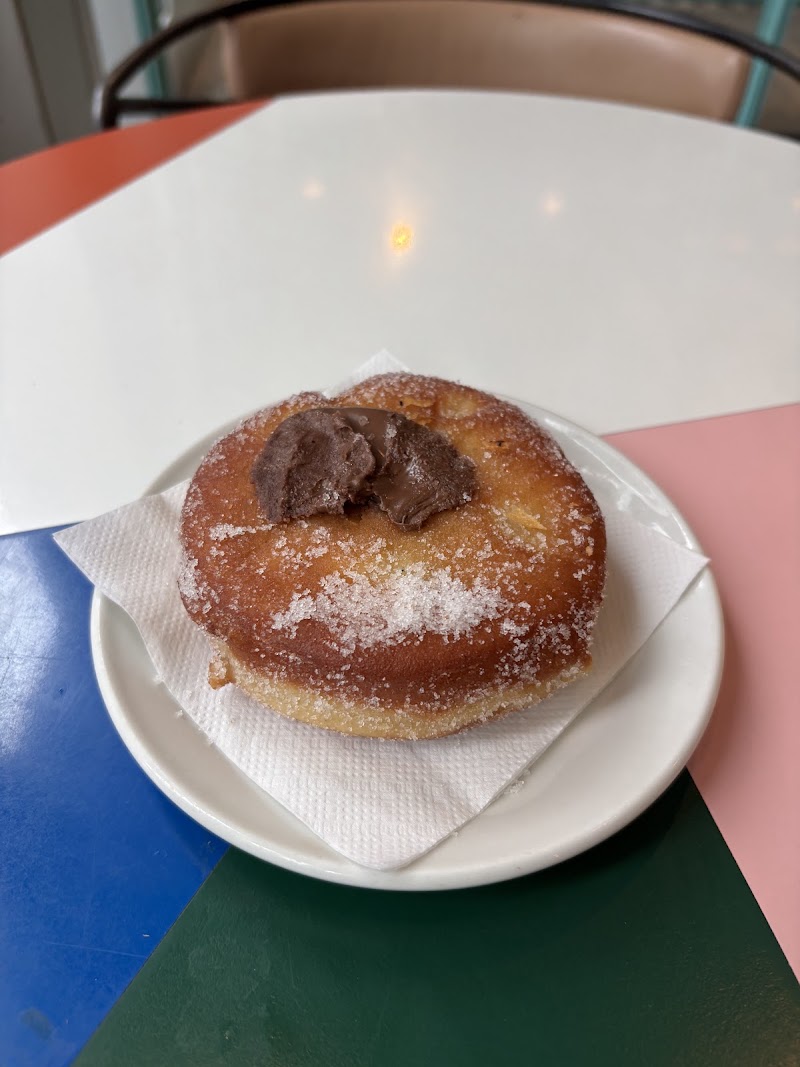
The food follows Italian bar logic, so it is organised by moment of the day rather than by category. In the morning it is cornetto-style pastry; at midday and through the afternoon it is sandwiches, on focaccia or on round rolls; late in the day it is the salty things that go with an aperitivo. A small Italian grocery corner rounds it out.
The house does not present itself as a bakery and does not publicly detail what is baked on site — on that point it is better to assert nothing. What is clear is the positioning: you eat here because you came to drink, not the other way round. Anyone after a proper sit-down lunch will find something better suited a few blocks away.
When to come
The rhythm is that of the business district: it opens before the working day starts, peaks hard as people arrive at work, peaks again in the middle of the day, drifts towards the aperitivo late in the afternoon, and closes in the early evening. This is not a night-time address.
The mid-morning and mid-afternoon troughs are the two windows where you can hope for a seat and an audible conversation. At the weekend the sector is markedly quieter than midweek, which changes the experience entirely: the same room turns measured, and that is probably the best moment to get to know it without being jostled.
Getting there
This is the Golden Square Mile, the western half of downtown, a short walk from the fine arts museum, the grand hotels on the slope and the main retail core. Peel station on the green line is the closest; neighbouring stations on the same line serve the district just as well, since it crosses on foot in a few minutes.
The sector is also one of the best connected to university campuses in the city: the two large downtown English-language universities are within walking distance, which explains part of the clientele. By bike, the protected downtown routes pass nearby. By car, aim for an underground garage — traffic and kerbside parking here are among the most difficult on the island.
Good to know
Three things worth knowing before you walk in. First, there are no bookings and the house makes a point of not taking calls: you simply turn up. Second, seats are few; if sitting down matters to you, aim for the troughs or the terrace in season. Third, the room is loud — that is the concept, not an accident.
In exchange you get something downtown Montreal rarely offers: espresso pulled on a lever machine, an unapologetically Italian roast, and a counter that serves you in two minutes without using speed as an excuse for mediocrity. If you have never drunk a coffee pulled by piston, that alone is reason enough to come.
Questions and answers
What does “caffettiera” mean?
It is the Italian name for the stovetop moka pot. The choice sums up the project: bringing the everyday, domestic version of Italian coffee downtown rather than a laboratory version of it.
Is the coffee roasted on site?
No. The espresso is a blend roasted in Italy, in the dark register typical of that school, pulled to order on lever machines and also brewed in moka pots.
Can you sit and work here?
This is not the place for it. The concept is a stand-up bar: few seats, present music, high turnover. For a working session with a computer, choose another downtown address.
Do you need to book?
No, and the house states plainly that it takes neither bookings nor calls. You walk in and order at the counter.
Is alcohol served?
Yes, there is a licence, and the aperitivo is part of the concept: the same counter moves from morning coffee to an end-of-day glass, as an Italian bar does.
Who designed the space?
Montreal studio Ménard Dworkind, who built a precise reference to 1990s Italian bars: checkerboard floor, sky-blue ceiling, deliberately fake wood and lights hung from yellow telephone wire.
Is there a terrace?
Yes, a pavement terrace in season. It is the configuration in which staying a while here is most comfortable.
Who are the owners?
They are not publicly identified. The business communicates about its concept and its coffee rather than about the people running it, and filling that gap with guesswork would be dishonest.
Opening hours
| Day | Hours |
|---|---|
| Monday | 07:30–18:00 |
| Tuesday | 07:30–18:00 |
| Wednesday | 07:30–18:00 |
| Thursday | 07:30–18:00 |
| Friday | 07:30–18:00 |
| Saturday | 07:30–18:00 |
| Sunday | 07:30–18:00 |
Photos
Visitor reviews
Reviews last updated: 2026-08-10 15:33:16
Data is refreshed monthly. Sources: montrealanka.com and editorial picks based on reviews.
Бар Caffettiera – безперечно один із найкращих кавових закладів у Монреалі. Атмосфера тут передає автентичну атмосферу італійського еспресо-бару: проста, жвава та гостинна. Еспресо чудове, капучино ідеально збалансоване,…
Яке чудове місце для смачного відпочинку на вулиці Стенлі! Мені дуже сподобалася автентична атмосфера та якість їжі. Це справді ідеальне місце, щоб насолодитися ідеально звареною кавою та щедро начиненим шоколадним тісте…
We came back on a beautiful sunny Sunday and once again loved everything about this place. It truly feels like stepping into an authentic Italian café—right down to the imported products and the atmosphere all the staff…
Прямо з Мілана 1990-х років, все: від напоїв (з дуже суворими правилами) до вітрини з закусками та напоями в пляшках, а також чудових італійських сендвічів у бірюзово-рожевій кольоровій гамі. Обожнюю макіато, граніта лат…
У самому серці центру Монреаля є безліч місць, де можна швидко випити кофеїну, але лише один бар Bar Caffettiera. Це культове місце не просто пропонує їжу та напої; воно пропонує майстер-клас з автентичної італійської го…