

Café · Montreal · ⭐ 9.5/10 · 949 reviews · updated: 2026-08-10 15:33:17
Address: 1207 Rue Shearer, Montréal, QC H3K 1H8, Canada
Some cafés are opened to launch a brand, and some are opened to carry on something that already existed. Clarke Café belongs firmly to the second kind, and the name says so. Clarke, in Montreal, was first of all an Italian bakery in the Mile End, a neighbourhood institution known for its sandwiches, where the present owner worked for some fifteen years before taking the idea on himself. The “PSC” attached to the sign means only one thing: Pointe-Saint-Charles, the working-class district in the south-west of the island where the family story moved to carry on living.
Highlights
- A direct descent from Boulangerie Clarke, the Italian bakery the family opened in the Mile End in 1980 and which stood for decades on its sandwiches. The café was not inspired by it: it is its continuation, run by someone who worked there for a decade and a half.
- The bread is baked on the premises, and that is the technical hinge of the whole operation: a sandwich counter that bakes its own base is not playing the same game as one that has it delivered.
- Espresso of the Italian school rather than the third wave: dark roast, medium body, cocoa notes — in a city where the conversation about coffee usually revolves around filter and single origins.
- The house blend carries the owner’s son’s name — the sort of detail that explains the nature of this business better than any pitch: a family concern, not a concept.
- The owner is often on the machine himself, which becomes rare as soon as a business grows past a single address.
- A second address in the West Island, in Kirkland: it was that second address that forced the recent move within Pointe-Saint-Charles, since the kitchen had to be large enough to prep for two sites.
What’s in the cup
This is worth saying at the outset, because otherwise a misunderstanding follows: this is not a specialty bar in the Montreal sense of the phrase. There is no monthly rotation of beans, no origin card on the wall, no rank of brewing devices behind the counter. The house keeps to the other tradition, the Italian bar: dark roast, a settled blend that does not change, an espresso built dense and made to hold its own in milk. That is a choice, not a gap, and it matches exactly what the neighbourhood comes in for.
The blend is described as medium-bodied with cocoa notes — a neighbourhood-bar profile, built to be drunk daily without tiring and to sit beside something savoury rather than be taken apart into descriptors. It carries the name of the owner’s son, which says a good deal about how the place understands itself. On who actually roasts that coffee, however, the business does not communicate publicly, and we are not going to invent a roastery to fill the empty box: what is certain is the style being aimed at and the stated attachment to goods imported from Italy.
The second thing worth knowing is that the owner works the machine himself much of the time. That changes consistency in a way which is otherwise hard to buy: when the person who set the house taste is also the one pulling the shots, the gap between the first order of the morning and the hundredth narrows. Milk drinks are the norm here rather than the exception, which is coherent in a place where almost nobody drinks coffee without something to eat beside it.
Who’s behind it
Frank Servedio. The story is documented and easy to tell: the Clarke bakery was opened by his family in the Mile End in 1980 and became an address known well beyond its own corner, largely on the strength of its Italian sandwiches. He worked there for some fifteen years. When he opened his own business in 2018 he did it not in the Mile End but in Pointe-Saint-Charles, slightly west of the current address, and under the name that was already the family’s.
What followed looks more like a neighbourhood business growing than a chain being rolled out. A second site opened in the West Island, in Kirkland, and it was precisely that site which made the move unavoidable: a kitchen was needed that could absorb the prep for two counters. The new room sits a few steps from the old one, in the same district, with the same people at the tables. Nobody relocates that short a distance in order to change their public; you do it when you want to stay exactly where you are and work better.
What kind of visit it suits
Eating quickly, alone or in a pair. This is the principal scenario by a wide margin. You come in, order at the counter, sit down in the room, move on. The logic of the place is the logic of a neighbourhood lunch: the sandwich is the product, the coffee comes alongside, and the service is built for flow rather than for settling in.
Takeaway. The other dominant use, and a structural one: a business grown out of a sandwich bakery has the takeaway format in its bones, platters and group orders included. For a picnic along the canal, a few minutes away on foot, that is probably the smartest use of the place in the warm season.
Meeting someone and talking. The room can take it: the tables and the layout are designed on the assumption that people actually eat rather than merely park a cup. Outside the rush it is a quiet local spot; at lunch you accept the noise and the traffic through the door.
Working with a laptop — with a caveat. Let us be honest rather than reassuring. The business publishes no policy on laptops and says nothing publicly about its wireless, and the format itself — a sandwich counter with a pronounced lunch peak — is not that of a café where you settle in for half a day with a file. There is no sign anyone is moved along; there is equally no sign the room is meant for it. If what you need is a long guaranteed work session, choose a place that makes that its stated offer.
The room and the atmosphere
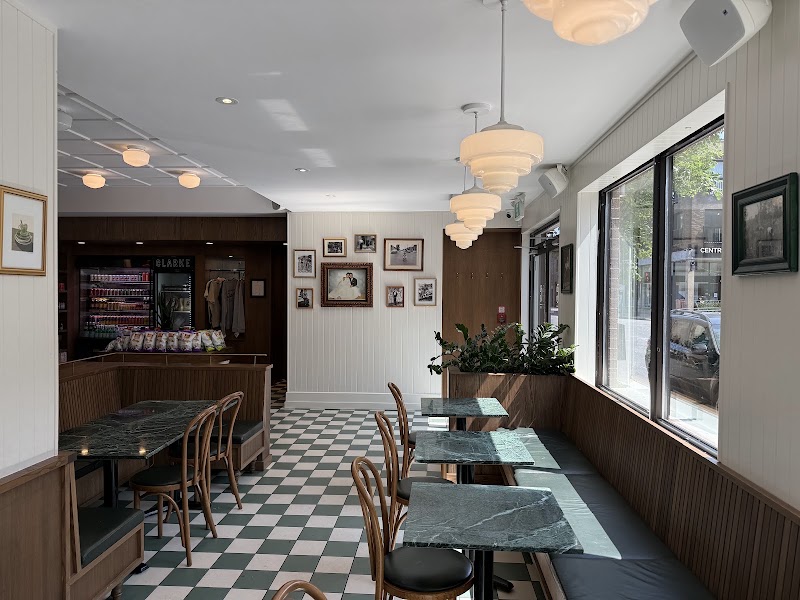
The present room is larger and more modern than the original, but the visual identity was carried over intact. Green-and-white chequerboard tiling is the most recognisable signal, joined by oak counters and furniture and green marble tables. A large island separates the counter from the dining area, and that single planning decision solves the classic problem of the format: the lunch queue no longer runs through the zone where people are eating.
What keeps the whole thing from reading as generic trattoria set-dressing is the family memorabilia hung around the room. It is not there to look vintage: it genuinely comes out of the history described above, and it is what gives the space its warm, slightly old-fashioned character. The overall feeling is of a working business rather than a photogenic location — the exact opposite of a café designed for social media.
On exact capacity, the existence of a terrace and the detail of the seating, the house publishes nothing precise, and we would rather not offer an invented figure. What can be said safely: this is neither a vast dining room nor a tiny counter, and lunch fills it.
What goes with the coffee
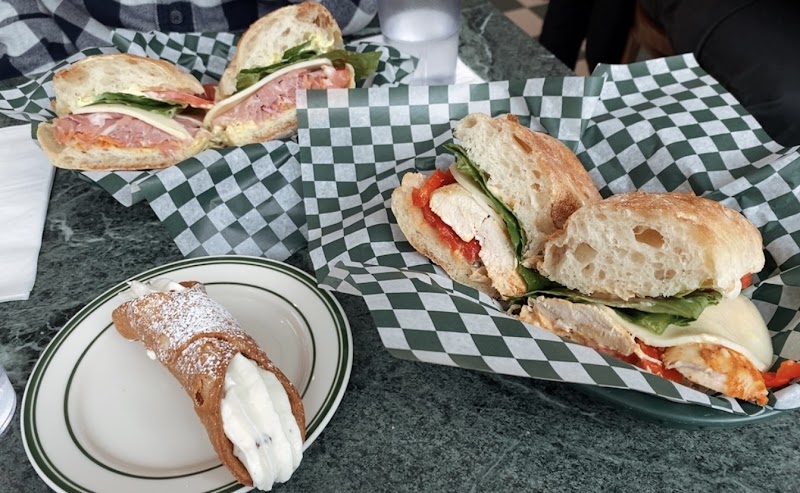
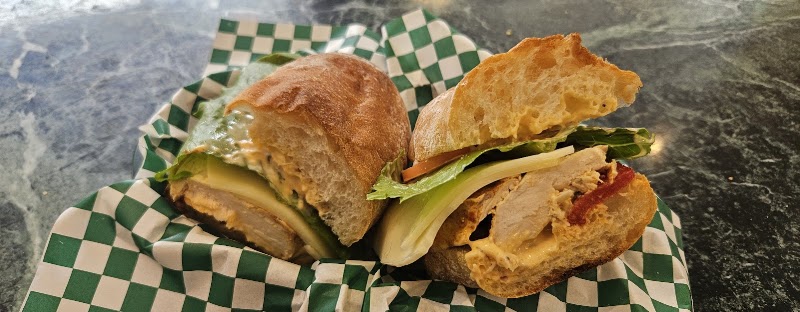
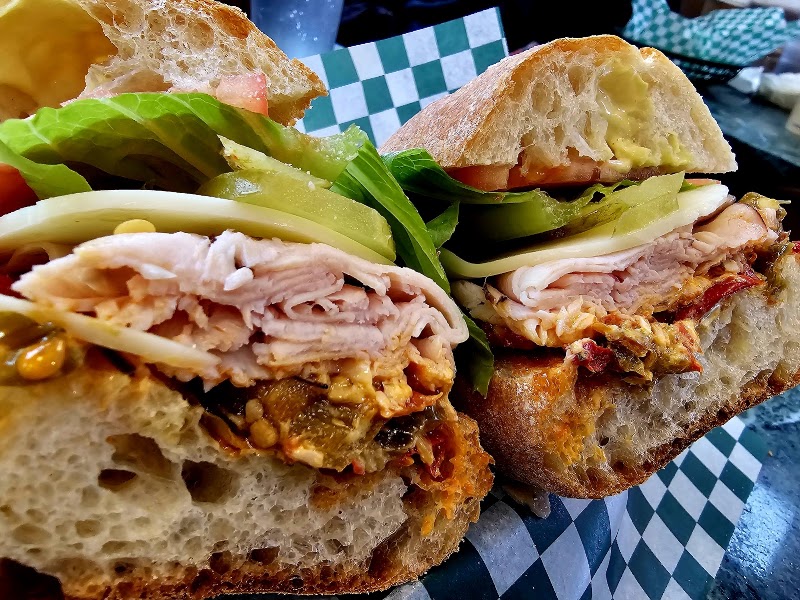
Here the question is almost inverted: the coffee accompanies the food. The house bakes its own bread — the single most important thing to retain — and builds on it a programme of Italian sandwiches inherited directly from the family bakery. The two signatures cited everywhere are porchetta and the breaded chicken cutlet, named here as markers of style rather than as a menu to copy out.
The pastry is also made in house, in the classic Italian register. In the morning the offer shifts towards breakfast sandwiches, and that shift is a genuine marker of use: the start of the day does not feed you the same thing lunch does. Vegetarian options were added along with the new room. And because the business comes out of a bakery, group orders and platters are part of the base trade rather than a bolted-on service.
When to come
The rhythm is that of a daytime neighbourhood business: an early opening with a public on its way to work, then a long peak around midday, then an afternoon that settles again and takes a conversation far better. The house closes towards the end of the afternoon; this is not an evening address, and it should not be counted on for a late supper.
If your priority is quiet and a free table, aim for the middle of the afternoon. If your priority is the sandwich at its best and the energy of the room, come at the peak and accept the queue. For a platter or a group order, give notice: it is done readily, but not improvised in the middle of the rush.
Getting there
We are in Pointe-Saint-Charles, the working-class district of the island’s south-west, wedged between the Lachine Canal and the old railway lands. It is one of the most industrial-historic sectors of Montreal, long outside the tourist circuits and now changing fast — which explains the very mixed public in the room.
By metro the nearest station is Charlevoix on the green line, and you should allow around ten minutes on foot from the exit. Several bus routes also serve the district. By bike the access is particularly good: the Lachine Canal path runs nearby and is by some distance the most agreeable approach in the warm season. By car, parking in the sector is residential and therefore uneven depending on the hour: it can be found, but not reliably right at the door.
Do not confuse the family’s two addresses: this is the Pointe-Saint-Charles one — that is precisely what the “PSC” denotes — while the second sits in Kirkland, in the West Island, an entirely different distance from downtown.
Good to know
This is a neighbourhood business, not a specialty destination: coming here expecting a single-origin filter and a conversation about fermentation means arriving at the wrong address and leaving disappointed for the wrong reasons. Coming for a dense Italian espresso and a sandwich on bread baked on site means understanding the place.
What we could not establish from a reliable source we will say plainly: the name of the roastery producing the house blend, the exact capacity of the room, the existence of a terrace and the policy on laptops are not publicly documented. On those points the best course is to ask on site. The rest — the descent from the bakery, the year of opening, the bread baked in house, the second address — stands solidly.
One last practical note: the lunch peak is real. If you are in a hurry, an order placed in advance will save you more time than any strategy about which hour to choose.
Questions and answers
Is this a specialty café?
No, and the business does not pretend otherwise. It keeps to the Italian bar tradition: dark roast, a settled house blend, espresso built for milk. No rotating beans, no manual brewing methods.
What is the connection with the Clarke bakery in the Mile End?
A direct one. The bakery was opened by the family in the Mile End in 1980, and the café’s owner worked there for some fifteen years before opening his own business in 2018 under the same name.
Is the bread baked on site?
Yes, and it is the central point of the whole operation. The pastry is made in house as well. It was precisely the need for a bigger kitchen that prompted the move within the district.
What does “PSC” in the name mean?
Pointe-Saint-Charles, the district. It is the tag that distinguishes this address from the second one, in Kirkland in the West Island.
Can you work here with a laptop?
Nothing forbids it, but nothing encourages it either. The business publishes no policy on the subject, and a format with a strong lunch peak does not hold a long work session. Outside the rush, in the afternoon, it is markedly more realistic.
Do you need to book?
No, it works as a counter: you order on the spot and sit down if a table is free. A platter or a group order, on the other hand, is better arranged in advance.
Is it easy to reach by metro?
Yes, with a short walk. Charlevoix on the green line is the closest station. By bike, the Lachine Canal path is the pleasantest route.
Are there vegetarian options?
Yes, they were added with the new room, alongside the classic Italian sandwiches that remain the heart of the offer.
Opening hours
| Day | Hours |
|---|---|
| Monday | 07:00–17:00 |
| Tuesday | 07:00–17:00 |
| Wednesday | 07:00–17:00 |
| Thursday | 07:00–17:00 |
| Friday | 07:00–17:00 |
| Saturday | 07:00–17:00 |
| Sunday | 07:00–17:00 |
Photos
Visitor reviews
Reviews last updated: 2026-08-10 15:33:17
Data is refreshed monthly. Sources: montrealanka.com and editorial picks based on reviews.
Один з моїх улюблених магазинів сендвічів у Монреалі. Сендвічі з котлетами – одні з найкращих, які я куштував. Ніколи не розчаровує. Свіжий хліб, свіжі інгредієнти. Обов'язково скуштуйте! Чудове місце, щоб випити кави та…
Чудове місце для сендвічів та кави. Я випадково натрапив на це місце, і там також грали у футбол, тож це була гарна альтернатива бару, без галасу.
Сам сендвіч був смачним зі свіжим хлібом та кавою, саме таким, яким я хо…
Чув чудові відгуки про цей заклад із сендвічами. Зайшов швидко пообідати на винос. Взяв сендвіч з курячою котлетою, аранчіні та салат "Цезар". Обслуговування було привітним, але мені знадобилося понад 15 хвилин, щоб отри…
Я замовила лате та тірамісу на винос. Дала чайові ще до того, як отримала замовлення. Дівчина простягнула мені напіввідкриту чашку з кавою, навіть не закрила її як слід і сказала використовувати термотрансферні рукави (н…
Їхні сендвічі смачні, але хліб завжди холодний, через що його неприємно їсти, особливо якщо замовляєш холодне м'ясо чи тунець. Шкода, що вони не пропонують можливість підігріти хліб; якщо клієнт просить, то чому б і ні?…